2 November 2026
Sliding vs hinged wardrobe: which to choose for bedroom and hallway
Sliding or hinged wardrobe? Compare space in front, depth, mirrors, hardware and interior fittings to choose for a hallway, bedroom or nursery.
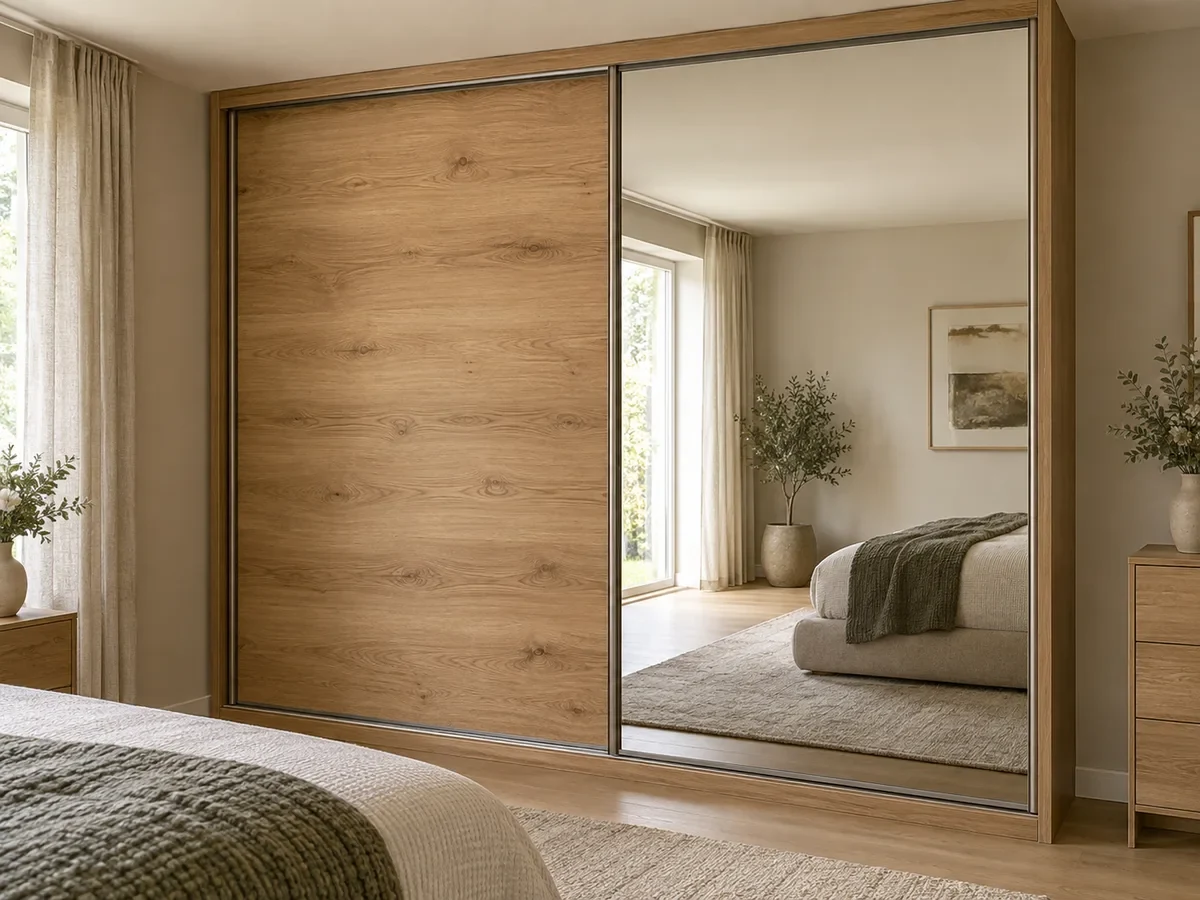
The short answer: a sliding wardrobe wins where there is little space in front of it — a narrow hallway or a small bedroom — and where you want large mirrors. A hinged wardrobe is better if you want full access to everything at once, need a shallower unit and prefer the simplest, most durable hardware. Let us go point by point.
Space in front of the wardrobe
A hinged door needs room to swing: a 40–50 cm door needs roughly the same amount of free space in front of the wardrobe, plus room for a person to stand. If there is a bed, a room door or a walkway nearby, the doors will get in the way. Sliding doors move along the front and take up no space in front of the wardrobe — in tight rooms this is their main advantage.
Access to the contents
With a hinged wardrobe you can open every door and see everything at once. With a sliding one only part is open at any time: about half with two doors, about a third with three. Keep this in mind when planning the interior: drawers are not placed where the meeting point of the doors covers them, otherwise they will not pull out.
Depth
Sliding doors run on tracks that take about 8–10 cm of depth. For clothes on hangers to fit crosswise, a sliding wardrobe is usually 60–65 cm deep or more. A hinged wardrobe for hanging clothes needs about 55–60 cm, and for shelves of linen or in a hallway it can be 35–45 cm deep. If every centimetre in the room counts, that is an argument for hinged doors.
Mirrors and appearance
A sliding wardrobe lets you use large full-height mirror panels that visually widen a hallway or bedroom. A mirror is possible on a hinged door too, but a heavy mirror loads the hinges, and the doors themselves are narrower. A hinged wardrobe is easier to fit into a classic interior, for example with routed painted MDF fronts.
Reliability of the hardware
Hinges are a simple and durable component: quality soft-close hinges (for example, Blum) last for years and adjust in three directions. With a sliding wardrobe everything depends on the system: the rollers, tracks and profiles. A good system runs quietly and smoothly, but it needs a level floor and precise installation, and the bottom track has to be kept clean. Cheap rollers are a common cause of misaligned and rattling doors.
Which wardrobe where
- Hallway: more often sliding — a narrow passage and a mirror by the exit. If the hallway is wide, a shallow hinged wardrobe also works.
- Bedroom: both work. If there is less than 70–80 cm between the bed and the wardrobe, go sliding; if there is enough room, choose hinged for full access.
- Nursery: a hinged wardrobe with soft-close doors is safer and easier for a child; sliding if the room is small, but then choose light doors and a smooth system.
Interior fittings
Inside, both types can be equally convenient:
- rails for long and short clothes (two rails one above the other save space);
- shelves for folded items, about 30–40 cm high;
- drawers for underwear and accessories;
- top storage for seasonal items and suitcases;
- pull-out baskets, trouser racks and a pull-down rail for high hanging space.
The carcass is laminated chipboard edged on all sides, with hardware by Blum, FGV and GTV. We show the interior in the 3D design so you can see in advance what goes where.
You get a free 3D design and a 360° panorama before signing a contract, remotely too, based on your measurements. Send us the size of your niche or see our custom wardrobes.
Send us your dimensions or an idea — a designer will prepare a free design and quote.