2 November 2026
Kitchen worktop materials: laminate, compact, quartz, acrylic or stone
How to choose a kitchen worktop: laminate, compact, quartz, acrylic or natural stone compared on water, heat, scratches, joints, care and cut-outs.
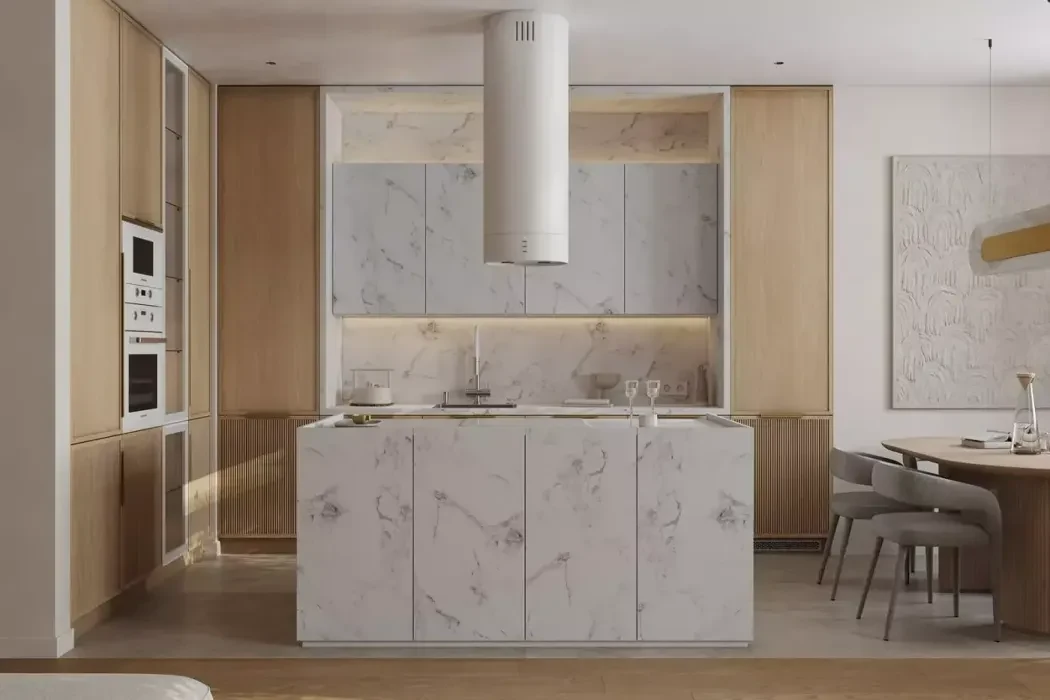
In short: a laminate worktop suits a budget kitchen, a compact laminate gives a practical and slim surface, quartz composite is durable and needs almost no care, acrylic solid surface is the choice for seamless shapes and an integrated sink, and natural stone is chosen for its unique pattern by people who accept its care requirements. Below is how these materials differ in everyday use and what to check when ordering.
Laminate worktop
The core is chipboard or MDF, usually 28–38 mm thick, covered with decorative high-pressure laminate (HPL). It is the most affordable option, with a huge choice of finishes: wood, stone and concrete looks.
- Water: the laminate surface is not afraid of water; the weak points are the edges and cut-outs. If water gets into an unprotected cut, the board can swell, so the sink cut-out is sealed with silicone.
- Heat: never put a hot pan directly on it — the laminate can blister or darken.
- Scratches and stains: it resists stains well, but always cut on a board.
- Joints: a corner kitchen always has a joint; it is clamped with connector bolts and sealant, and it stays visible.
Compact laminate
This is solid high-density laminate about 10–12 mm thick, made of one material all the way through. It is not afraid of water even at the edges, so the sink can be mounted from below, under the worktop. The slim profile looks great in modern kitchens. It handles stains and moderate heat well, but hot cookware is still better placed on a trivet. In price it is noticeably more expensive than laminate and usually cheaper than quartz. One nuance: it needs special tools to machine, so cut-outs are made in advance from an exact template.
Quartz composite
About 90% natural quartz grit in a polymer binder. It is hard and non-porous, barely absorbs wine, oil or coffee and needs no sealing. It resists scratches better than most materials. Its weak points are sudden temperature changes and direct heat: because of the resin, a hot frying pan goes on a trivet. Thickness is usually 12–20 mm, often with a thicker bonded front edge. Joints are glued with colour-matched adhesive: on plain and fine-grain finishes they are almost invisible, on bold veining they show more. Price is above average.
Acrylic solid surface
Mineral filler in acrylic resin. Its main advantage is that it is seamless: parts are glued and sanded so the joint cannot be seen, and a sink of the same material can be bonded flush. It feels warm to the touch and does not absorb moisture. The downside is that it is softer than quartz: it scratches and does not like heat, but small scratches and marks can be sanded out and restored. Price is average or above, depending on the brand and colour.
Natural stone
Granite is very hard and withstands heat and scratches, but it is porous and needs periodic sealing. Marble is beautiful but softer and sensitive to acids: lemon, wine and vinegar leave dull marks. Every slab is unique, and joints are matched to the pattern. Stone is heavy, so the base cabinets must be sturdy. It is usually the most expensive option.
Thickness, cut-outs and care
- Cut-outs for the sink and hob are made from the template of the exact model, so choose your appliances before the final design.
- A sink can be inset from above (works with any material), flush-mounted or undermounted (for compact laminate, quartz, acrylic and stone).
- Leave enough distance from a cut-out to the edge and to any joint, otherwise a narrow strip can crack.
- Care: a soft sponge and a neutral cleaner; no abrasives on acrylic and laminate, no acids on marble.
The cost of a worktop depends heavily on the material, thickness and the number of cut-outs and joints, so it is easiest to choose it together with the kitchen design.
We make custom kitchens to your measurements. You get a free 3D design and a 360° panorama before signing a contract, remotely too, based on your measurements. Send us your measurements or get a kitchen estimate.
Send us your dimensions or an idea — a designer will prepare a free design and quote.